
UNESCO monuments, newly accessible sites and a new archaeological terroir for Pythagorion.
Samos has always been an island with an extraordinary past. But there has perhaps never been a better moment to look at that past again.
Across the island, important archaeological and historic sites are being restored, reopened and reimagined for visitors, while a wider plan is gradually bringing the monuments of ancient Samos together into a much more complete experience.
And at the heart of it all are Pythagorion and the Heraion of Samos, together inscribed on UNESCO’s World Heritage List since 1992.
Why Samos matters
More than 2,500 years ago, Samos was one of the great maritime and commercial powers of the Greek world.
Its wealth and connections helped create an extraordinary period of architecture, engineering, sculpture and intellectual life. UNESCO recognizes Pythagorion and Heraion not simply for their age, but for the remarkable innovation they represent.
At the Heraion stood one of the largest temples of the ancient Greek world, dedicated to Hera, the goddess believed by the Samians to have been born here. At Pythagorion, the remains of the ancient fortified city tell the story of a sophisticated urban centre, while the famous Eupalinian Aqueduct remains one of antiquity’s great engineering achievements: a tunnel more than one kilometer long, excavated through a mountain from two opposite sides in the 6th century BC, designed by Efpalinos engineer.
This was also the world of Polycrates, Pythagoras, Epicure and Aristarchus — an island looking far beyond its own shores.
The Heraion: looking again at a great sanctuary
The archaeological site of the Heraion is entering a new phase.
Following more than a century of archaeological work by the German Archaeological Institute (DAI), a new masterplan has been completed in cooperation with the Greek Ministry of Culture. Its purpose goes beyond preserving individual ruins: the aim is to make the long history and extraordinary scale of the sanctuary easier for visitors to understand.
New plans include improved visitor routes and services, further conservation and protection of the monuments, fire protection and measures addressing the effects of climate change and coastal erosion.
For today’s visitor, however, the magic remains wonderfully simple.
Walk through the ancient sanctuary towards the solitary standing column of the colossal Temple of Hera and try to imagine it as part of a temple surrounded by 155 columns rising to approximately 20 meters. The single column has become one of the most recognizable images of ancient Samos — but the archaeological landscape around it tells a much bigger story.
Something genuinely new to see: the Early Christian Cemetery
One of the most interesting recent additions to the visitor experience is in Pythagorion.
The Early Christian Cemetery at Glyfada (near the entrance of Doryssa Seaside Resort) has now been restored, landscaped and opened as a fully visitable archaeological site.
Used from the 4th until the middle of the 7th century AD, the cemetery reveals another Samos — the island during the transition from the ancient world to Christianity.
Archaeological work uncovered a 4th-century Martyrium, 28 cist graves and 17 arcosolia, while older Hellenistic tombs were also reused. Finds included jewelry, crosses, pottery, around 500 lamps and nine gold solidi dating to the age of Justinian.
New visitor paths, lighting, information panels and viewing and resting areas now make a site that was largely unknown to most travellers part of the archaeological experience of Pythagorion.
It is one of the places even returning visitors to Samos may not yet have seen.
Pythagorion is becoming an archaeological journey
A new masterplan announced in September 2026 proposes treating Pythagorion not as a collection of isolated monuments, but as one interconnected archaeological landscape.
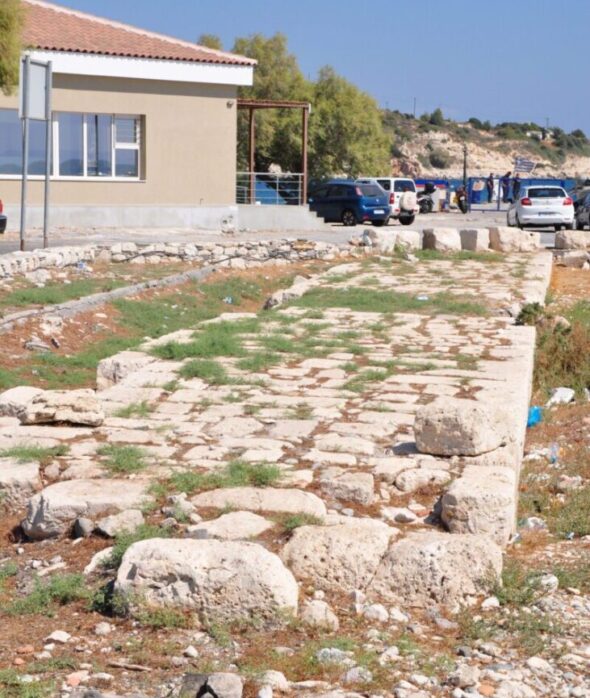
The idea is remarkably appropriate for the town. Ancient Samos is quite literally beneath and around modern Pythagorion.
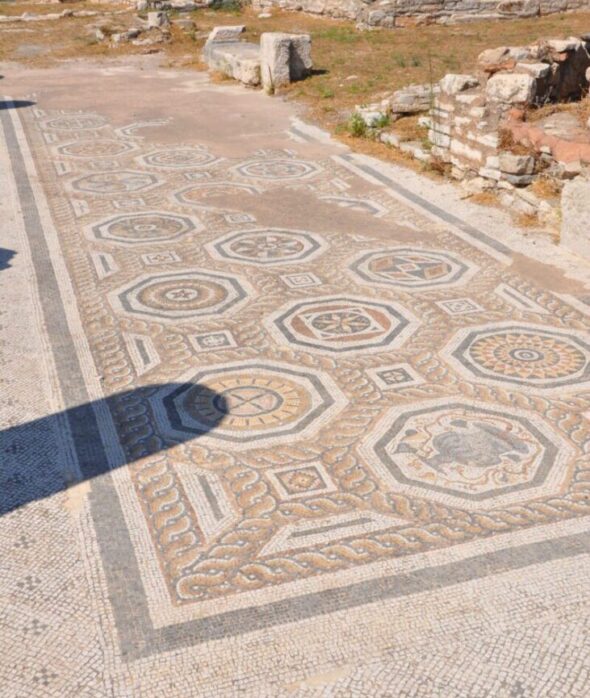
The Archaeological Museum, Ancient Agora, Roman Baths, ancient theatre, Eupalinian Aqueduct, ancient fortifications and harbor, cemeteries, sanctuaries, the Castle of Lykourgos Logothetis and the newly restored Early Christian Cemetery all belong to different chapters of one continuous story.
The long-term vision is to connect them through walking routes, better signage and public spaces, improved access and digital interpretation, gradually creating an archaeological park integrated into the living town.
In other words, visiting Pythagorion could increasingly become less about driving from “site A” to “site B” and more about walking through the layers of an ancient city.
More than archaeology
The programme extends beyond classical antiquity.
Restoration projects are also bringing later chapters of Samos back into view. The remarkable post-Byzantine church of Ai Giannakis in Ano Vathy (Pano = Ano = upper), with its distinctive four domes, has been restored and returned to the public, while work has also focused on important Byzantine and post-Byzantine monuments elsewhere on the island.
Together, these projects remind us that the history of Samos did not end with Pythagoras or Polycrates. It continued through Roman, Early Christian, Byzantine and later island life.
A great investment in the island’s heritage
During her visit to Samos in August 2025, Greek Minister of Culture Lina Mendoni inspected many of these projects and announced that Ministry of Culture works on the island represented an investment of more than €20 million.
Since then, some of those projects have moved from plans and restoration sites to places that visitors can actually experience.
And the direction is becoming clearer: preserve the monuments, certainly — but also make them easier to discover, understand and connect.
See Samos differently
If you have visited Samos before, its archaeological heritage deserves another look.
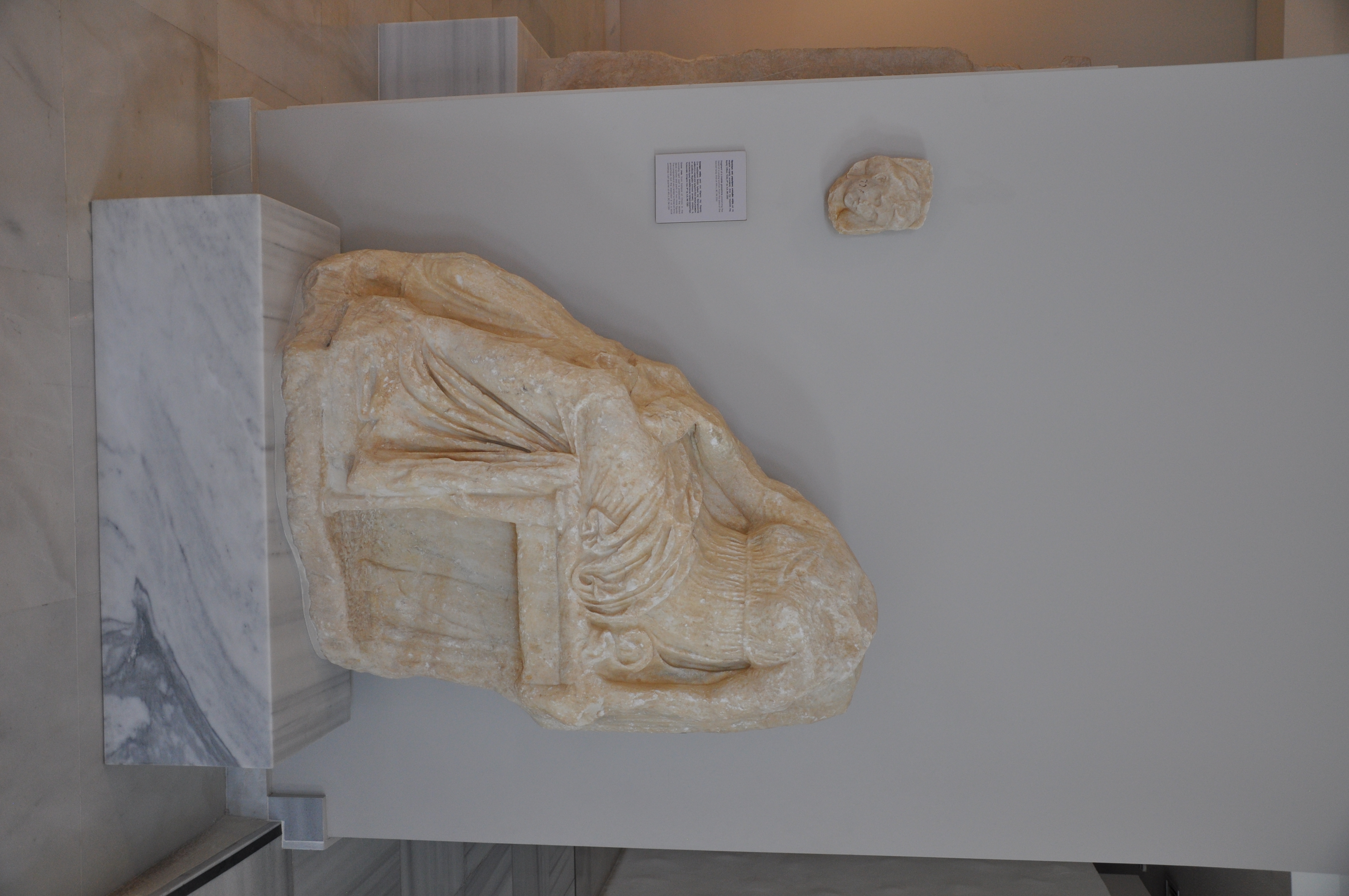
Begin at the Archaeological Museum of Pythagorion. Walk through the town knowing that beneath today’s streets once stood one of the most important cities of the ancient Aegean. Visit the Eupalinian Aqueduct and consider the engineering required to create it 2,500 years ago. Continue to the Hereon and stand beside the surviving column of a temple once designed on an almost unimaginable scale. And now add the Early Christian Cemetery to that journey.
And of course, don’t limit your tours at the above-mentioned sites. The Samos town Archaeological museum still holds impressive findings and historical facts, while Karlovassi has the castle from the Middle Ages and the Byzantine Metamorphosis chapel (both in Potami waterfalls), while Marathokampos is your destination to visit Pythagoras Cave!
Samos is not acquiring a new history.
It is finding new ways to reveal the extraordinary history it has always had.
#samos #archaeology #ancientgreece #unesco #andini #mysamos